


Introduction
Standing around somewhere is not automatically a crime. Whether it counts as loitering depends on where you are, the local law, and what is happening. This short guide explains the meaning, how it differs from trespassing, and what to do if police approach you.
Key Takeaways
Loitering laws depend on where you are and what is happening, not simply on how long you remain in one place. I’d check the local rule and the circumstances before drawing conclusions.
- Loitering generally means remaining somewhere without an apparent purpose, but legal definitions vary.
- Staying in a public place is not automatically a crime; local laws may require additional circumstances or intent.
- Trespassing generally involves being somewhere without permission, while loitering can occur in places open to the public.
- Possible consequences range from a warning or direction to leave to fines or other penalties under local law.
- If police stop you or charge you, stay calm, avoid arguing, and consider getting advice from a local lawyer.
What Is Loitering?
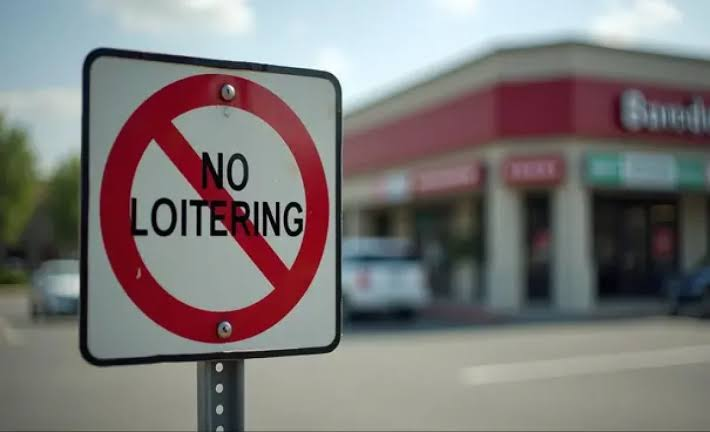
When people wonder what loitering is, they are referring to people just standing around somewhere without having a clear justification for being there.
This is the general way of defining loitering but in legal terms, this is only the basic definition since the law can narrow down the definition and take into account the intent of the individual.
It is also important to note that the location is a critical element in the offense since loitering committed at different locations such as a public street, transit station, school and a private property might differ based on certain ordinance requirements.
One ordinance might define loitering in relation to blocking or obstructing access while another might have specific circumstances that are covered.
Since the definition is subjective, the circumstances of how one came to be in that location, if the individual was ordered to leave and even if he or she caused obstruction might be considered.
Is Loitering a Crime?

In all places in the United States, loitering does not always constitute a criminal offense. The basis for citation or arrest is the specific law, the location, and the activities or intentions of the alleged offender. It may not be sufficient just based on a general notion that the person is “just loitering.”
There are some laws that only criminalize loitering in certain circumstances or where loitering is related to certain activities.
There have been cases wherein loitering laws were challenged because of vagueness in their provisions or due to discretionary power given to officials by such laws.
To get an idea about differences among loitering laws in the U.S., refer to this article on loitering laws.
Standing in a public place is not a crime by itself. What usually matters is the local ordinance, the location, and whether someone was obstructed or lawfully told to leave.
The police have the authority to ask an individual to move on; however, the implications associated with that request differ according to their legality.
A warning or request to move does not always equate to an arrest or any legal action against the individual making the request.
Common Examples of Loitering

It is a term that may relate to many scenarios that vary widely, with the same act being legal in one scenario and unlawful in another.
It might be for a legitimate reason in other scenarios, even if the reason behind the act is not obvious to a third party. The local law and circumstances play a vital role here.
These illustrations are broad examples and do not mean that each of these acts would necessarily constitute an offense.
Depending on the locality, the offense can only come about if the act meets a certain criterion, such as obstruction of passage and remaining after being told to go by lawful means.
| Situation | Why it may draw attention | What can matter |
|---|---|---|
| Remaining near a business entrance | People may be unable to enter or exit freely | Whether access is actually blocked and what local rules say |
| Staying on school grounds without an apparent connection | The location may have access restrictions | Permission, the person’s reason for being there, and posted rules |
| Lingering in a transit facility | Some facilities restrict particular activity or use | The facility’s rules and the conduct involved |
| Gathering in a public area | A group may be perceived as disruptive | Whether anyone is obstructed, threatened, or disturbing the peace |
The place that raises questions does not determine whether there has been a violation of law. What is important is the particular law, any directions that have been issued, and the behavior of the individual.
Loitering vs. Trespassing
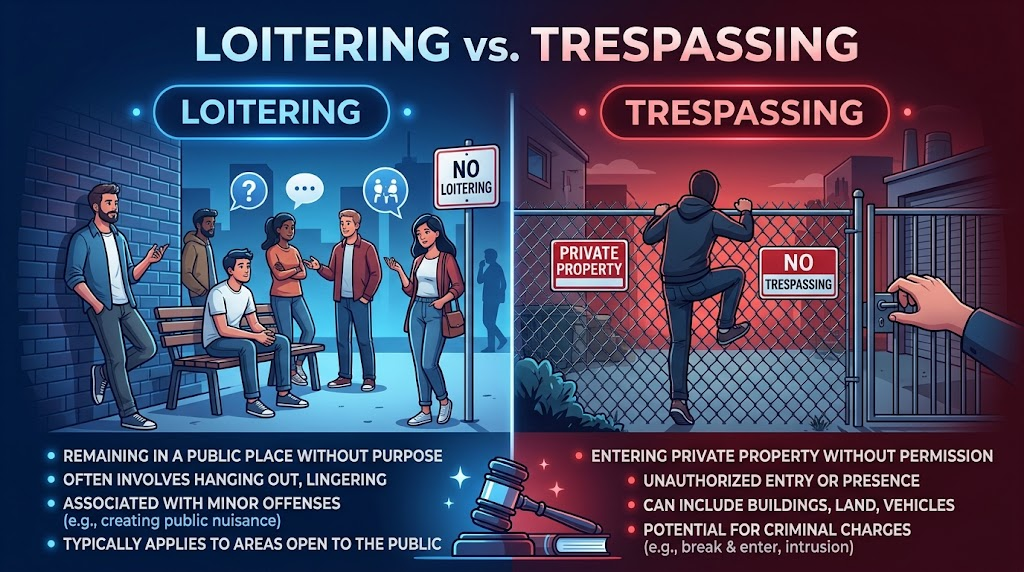
Loitering and trespassing are two distinct terms, but the same situation may encompass both. Loitering usually relates to lingering in a place where the law applies, while trespassing usually involves staying on a piece of land without consent or failing to comply with a legal order to vacate.
One may loiter in a public place without trespassing especially when they have a legal reason to be there and are not breaking a particular rule.
On the other hand, one can commit a crime of trespass when they enter or remain in private property without having any authority to do that regardless of whether or not they have been there for too long to be termed as loitering.
Permission, property lines, signs, and even the demand that one leave the premises can be pertinent issues.
A “no loitering” sign does not solve all the legal problems on its own and the mere presence of someone at a private property cannot be an evidence of trespassing alone.
Penalties for Loitering

There is no one penalty that applies universally for loitering. Depending upon the jurisdiction and the alleged conduct, the result may be no enforcement action, being asked to leave, a warning, citation, or arrest. The term itself is not a determining factor as to the proper remedy available under the law.
If there is a local ordinance criminalizing certain conduct, it could result in penalties such as fines or other court imposed punishment.
The results will depend on whether the conduct constitutes an infraction or a misdemeanor, along with any accompanying allegations of conduct, or previous convictions.
Each of these is different for each jurisdiction, so generalized penalty levels are often inaccurate.
A citation is not a conviction. Keep the paperwork, note the response date, and read what the ordinance actually requires before deciding what to do next.
It is also important to understand that a charge is not a guilty verdict. In most cases, the government will need to prove the elements of the particular crime, and the defendant may have a defense to the charge based on the language of the statute or the specific facts.
If you have received a citation or been charged with a crime, consult your local statute and court schedule to understand what you need to do.
Your Rights If You’re Accused of Loitering

An allegation is no indication of a crime having been committed. Relevant legal considerations, reason for presence at the scene, and the nature of events are pertinent here. I would maintain a calm demeanor and observe relevant information which might prove useful later on.
If police stop you, stay calm and keep it simple. Ask whether you are free to go, and write down what happened as soon as it is safe to do so.
What to do if police stop you
If an officer approaches you, try to remain calm and avoid physical resistance. You can ask whether you are free to go; the answer to the question and the context will help clarify whether the interaction is voluntary or involves detention.
If the encounter results in an arrest that you believe was unlawful, the circumstances may raise separate wrongful arrest issues.
Do not tell lies or threats, and do not agree to the search to end an unpleasant conversation.
Here are a few steps that may be useful to document what happened and to preserve your rights:
- Ask politely whether you are free to go.
- Do not argue with or resist an officer physically.
- Do not give any false information or guesses.
- Record the time, location, and names or badge numbers you can observe without any risks afterwards.
If you are issued a citation or any other document related to court proceedings, preserve it and record the response date.
If a police report was prepared, knowing how to read a police report can also help you identify the information recorded about the encounter and compare it with your own records.
What you say and do during the stop might have implications for you. If you believe an officer violated your rights or engaged in police misconduct, documenting what happened and speaking with an attorney may help you understand your options.
When to speak to a lawyer
If you’ve been arrested, accused of something, or asked to attend a court hearing, then it would be wise to contact a local defense attorney.
They will be able to analyze the specific ordinance, walk you through the process for that area, and help you know about potential defenses you may have. If you have a time limit, don’t wait until after the time is up to get help.
If an interaction with the police has resulted in an injury, then LawyerHelpNow says that it is where people can find a personal injury lawyer without paying anything.
The service will give you a chance for a free evaluation from LawyerHelpNow. According to its website, this case evaluation is done for free.
Frequently Asked Questions
What does loitering mean?
Loitering generally means lingering or remaining in a place without an apparent purpose, but legal definitions vary by jurisdiction and situation.
Is it illegal to wait in a public place?
Not necessarily. Waiting in a public place is not automatically a crime; a local law may require additional circumstances or conduct.
Can police ask someone to move along?
Police may make a request or give a direction in some circumstances, but the authority to do so and the consequences of refusing depend on local law and the facts.
Is loitering the same as trespassing?
No. Loitering laws concern remaining somewhere under specified circumstances, while trespassing generally concerns being on property without permission or refusing to leave when legally required.
Can a person be arrested for loitering?
An arrest may be possible where local law allows it and the facts support the offense, but loitering is not treated the same way everywhere. A request to move is not automatically an arrest.
What penalties can apply to loitering?
Depending on the local law and the alleged conduct, consequences may range from a warning or citation to a fine or other court-imposed penalty.
Should I talk to a lawyer about a loitering charge?
It can be helpful to speak with a local lawyer if you are charged, arrested, or given court paperwork. A lawyer can explain the applicable law, deadlines, and possible defenses.