

Introduction
A police report can feel like the final word on what happened but it isn’t. Learning to read it section by section helps you spot what’s fact, what’s opinion, and what might need a closer look before it shapes your claim.
Key Takeaways
A police report can help me understand how an officer recorded a crash, but it is only one part of an injury claim. Knowing how to read a police report can help me review the details carefully, check them against what I remember, and follow up on any discrepancies.
- The report records key details about the people, vehicles, scene, and officer’s observations.
- A police report is not necessarily a final decision about who is legally at fault.
- Codes and abbreviations can vary by state and agency, so I check the report’s own key or contact the department.
- I compare the narrative and diagram with other available evidence and my recollection.
- If I find a factual error, I ask the reporting agency how to document or correct it.
Why Reading Your Police Report Matters for Your Injury Claim

A police report is only one part of the documentation that may matter after a crash. If you are still dealing with the immediate aftermath, our guide on what to do after a car accident covers the steps to take at the scene and afterward.
First, I differentiate between what the officer saw with his or her own eyes and what another individual reported and what the officer concluded based on that information. Diagrams, a ticked box, or a narrative might lack the necessary context, and a report might not contain all the witnesses and evidence gathered. A report is only one document among others.
First, I differentiate between what the officer saw with his or her own eyes and what another individual reported, and what the officer concluded based on that information.
In case there is anything wrong or vague, I would record the exact page number or the exact entry number and seek assistance from the agency responsible for preparing the report as to how to bring the matter up. This may vary by state and agency.
In this regard, this New York crash-report manual can be referenced as an illustration. On the other hand, if I wish to evaluate whether the report brings up any issues related to my case, I can use LawyerHelpNow.
What Is in a Police Accident Report?
Police accident reports are official documents that are made by the police officer after dealing with an accident; but their format differs from place to place. In most cases, they include the nature of the incident, parties involved, and the officer’s description of the accident. Not all accident reports include the same information, and some parts of them might be blank because of missing information.
The Header Section — Basic Incident Information
In most cases, the header includes the number of the report or case, the date and time, the location of the accident, and the responding agency or officer. I begin with these pieces of information because a mistake in any of them such as wrong date, street name, or case number will cause difficulties in linking the document to the accident.
Party and Vehicle Information Section
In most cases, this section includes a list of drivers, passengers, vehicle information, and insurance details. I verify if the names and vehicle descriptions listed in the report correspond to those I remember, but do not rely on the report since not all details are mentioned in it. “Unit 1” is usually used in reports to indicate a vehicle or party; the term alone is not an indication of liability.
Witness Information Section
This section usually contains the name and contact details of the witness along with his/her statement about what he/she saw. I look into the witness statements mentioned in the report to verify if they are mentioned there and make sure the statement provided by the witness corresponds to what he/she saw. Lack of witness statement does not mean he/she was not there.
I begin with these pieces of information because a mistake in any of them — a wrong date, street name, or case number — will cause difficulties in linking the document to the accident.
Diagram and Scene Description Section
It could include vehicle locations, their direction of movement, location of impact, and any road-related elements that might exist close by. The diagram is compared to photographs and memory for information about orientation and labeling instead of expecting it to be drawn to scale. Scene notes might contain information about traffic controls, weather, lighting, or road conditions, depending on the format used.
Officer’s Narrative Section
This is the part of the report where the officer gives a written summary of the incident and his/her response to it. It should be read carefully to determine whether specific information is reported as having been stated by a driver or witness or whether it was simply an observation made by the officer.
Contributing Circumstances and Violation Codes
This space can document any conditions the officer considers contributing to the accident, as well as any citations or traffic law information. They can aid in asking questions related to the event, but the report itself cannot conclusively determine civil responsibility because of its codes and analysis. One who wants to compare different report formats should refer to this accident report guide, knowing that forms and language are dependent on the location.
Injury and Property Damage Section
This section can show whether people were reported to be hurt, as well as any damage to property or vehicles. I review whether the information matches what was documented at the scene, while remembering that symptoms of an injury or the extent of damage may become clearer after the initial assessment. If an insurer later disputes or denies an injury claim, it may also be useful to understand what to do if your injury claim is denied by insurance.
How to Read Each Section of a Police Report
After reading through the entire report once, I draw my conclusions. During a second read through, I compare the individuals, locations, and order of events in the header, diagram, and narrative sections. When there is a common fact presented differently in two areas, I flag both instead of deciding on only one without giving an explanation.
Short reviews ensure that my observations do not mix with assumptions. I record everything stated in the report, what I remember, and also check the other documents for confirmation. For instance, the following format may be used during my review:
- Verify the date, location, case number, and names.
- Compare diagram and narrative with photos and my memory.
- Highlight any discrepancies, lack of facts, or unclear points by mentioning the page and field.
- Save copies of the relevant documents to explain the differences.
Short reviews ensure that my observations do not mix with assumptions. I record everything stated in the report, what I remember, and also check the other documents for confirmation.
Later on, I go back to each detail that has been flagged up and determine if it is either a factual error, an incomplete description, or a matter of interpretation. There is a significant difference between misspelling of a person’s name and the way in which an accident took place. I do not edit anything on my own in the report but rather contact the issuing authority regarding their procedure.
Common Police Report Codes and Abbreviations Explained

While codes may help condense a report, there is no uniformity of use in all states and law enforcement agencies. First, I search for a key or legend provided at the end of the form or explanation by the agency making the report, and then interpret the entries accordingly. Here are some general guidelines to interpreting certain codes, but not necessarily those used in any particular report.
Traffic Violation Codes — What They Mean for Fault
The report may include a statute number, description of the violation, or indication that a citation was issued. I analyze the full text of the code and, where necessary, the statutes of the appropriate jurisdiction rather than trying to interpret the code on my own. A citation or violation listing may be significant, but it does not automatically decide a civil claim. Depending on the jurisdiction and circumstances, comparative negligence may also affect how responsibility is considered.
Injury Severity Codes — O, C, B, A, K Explained
The injury severities of some crash-reporting systems in the United States employ the use of alphabets. The most widely employed system is presented below, but I always confirm the legend from the report since the agency may utilize other descriptions or classifications.
| Code | Common Meaning | What to Check |
|---|---|---|
| O | No apparent injury reported | Whether the report records symptoms or a later evaluation |
| C | Possible injury | The agency’s definition and the notes for the person |
| B | Non-incapacitating injury | The form’s wording and any supporting records |
| A | Incapacitating injury | The agency’s specific classification criteria |
| K | Fatal injury | The report’s legend and official incident details |
These labels describe how the report classified injury information; they are not a medical diagnosis. I compare them with relevant medical records and clarify any apparent mismatch through the proper agency or claim process.
Vehicle Damage Codes and What They Signal
Fields describing damage may make use of digits, alphabetic characters, graphics, or text to describe the damaged area or the appearance of the damage. There is no universal code system that I can rely upon to be used consistently throughout the forms. I review the legend on the form and compare the recorded area against photographs and estimated repairs.
Weather and Road Condition Codes
There may be abbreviations on the form to indicate rain, snow, dry or wet roads, light, or some other condition on the scene at the time of the accident. I will consider whether the weather or road condition codes entered on the form are consistent with the time and place of the accident, as well as how this information was acquired by the report writer.
Contributing Factor Codes and How They Affect Your Claim
The “contributing factor” box can be used to document the officer’s perspective regarding issues like driver behavior, visibility, or roadway conditions, based on the form. I see this as a point of inquiry, not as a full discussion of culpability. The rest of the story, the drawing, the testimony of witnesses, etc., can provide additional context or even challenge the information provided here.
How to Identify Errors in a Police Report

I start by confirming basic information such as names, contact information, information on the vehicles, date, time, and location. Then, I review the diagram and description against the photos, messages, and my recollection of the accident. It might be simple to note an incorrect fact while a difference in how the accident occurred requires supporting evidence.
Where I notice a problem, I document which part is incorrect, the information on the report, and the correct one. The explanation should be brief and supported with relevant documents instead of presumptions on why there was an error.
I start by confirming basic information such as names, contact information, vehicle details, date, time, and location. Then I review the diagram and description against the photos, messages, and my recollection.
I contact the department or agency responsible for creating the report and inquire if it would be willing to accept corrections or additions to its document, and how much paperwork is required in that case.
The processes vary, and the agency may not alter the findings of the officer simply because an individual disagrees with them. If I need help understanding how an error, omission, or disputed statement in a police report could affect an injury claim, I can review guidance on when to hire a personal injury lawyer and consider whether legal assistance is appropriate for my circumstances.
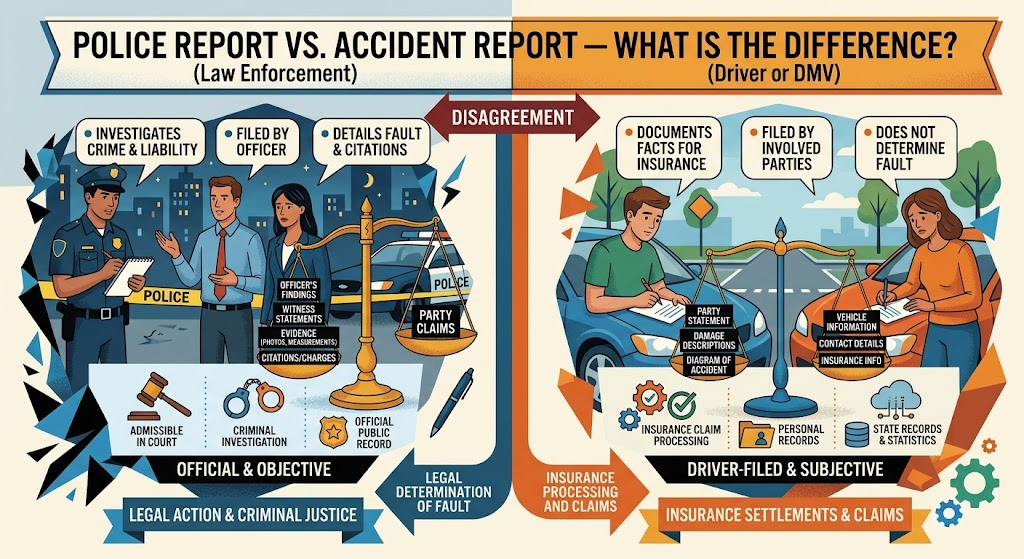
Police Report vs. Accident Report — What Is the Difference?
People have different meanings for “police report” and “accident report,” and thus, I examine the document and not take the meanings of these terms as being identical. The police accident report refers to a document completed by an officer after investigating a crash accident. Accident reports may refer to a document filled out by a driver, insurer, or other relevant parties.
The police report may later become one of the documents reviewed during an insurance claim. If you are also dealing with the claim process, you may want to understand how long an insurance claim takes and what factors can affect its progress.
It is important that I check the issuing agency, title, instructions, and case number to figure out what I have. If there is a need for a specific version of a form, I inquire at the corresponding agency about which forms are available. LawyerHelpNow provides a free case evaluation for individuals who want to seek legal assistance after an accident.
Seeking the Right Legal Help
If questions about the police report, an injury claim, insurance coverage, or responsibility remain unresolved, you can learn more about working with a car accident lawyer through LawyerHelpNow and request a free case evaluation.
Questions About Your Police Report or Injury Claim?
Our intake specialists are available 24/7 to listen, help you understand your options, and connect you with a qualified attorney at no cost.
Frequently Asked Questions
These answers offer general guidance; report formats and procedures can vary by location. I check the instructions from the agency that prepared the report when I need a jurisdiction-specific answer.
How do I get a copy of a police accident report?
I contact the agency that responded or its records division and ask about the request process, eligibility, fees, and expected timing. Some jurisdictions also provide an online request option.
Does a police report determine who was at fault?
Not necessarily. The report may contain observations, statements, citations, or an officer’s assessment, but fault in a claim can depend on other evidence and applicable law.
What should I do if information in the report is wrong?
I identify the exact error, gather documents or other information that supports my account, and ask the issuing agency how to submit a correction request or supplemental statement.
What does Unit 1 mean on a police report?
It is commonly a label used to identify a vehicle or party in the report. It does not, by itself, mean that person was found legally responsible.
Are police report codes the same in every state?
No. Codes and abbreviations can differ by state, agency, and form, so I use the report’s legend or ask the department to explain an entry.
Can a police report list no injury if symptoms appear later?
Yes. A report reflects information recorded at the time, and some symptoms may become noticeable later. I seek medical care when needed and keep records of relevant updates.
Is an accident report the same as a police report?
Not always. The terms can refer to different documents, including an officer-prepared report or a form submitted by a driver. I check who created the document and why.