

Pure Comparative Negligence: How Fault Affects Your Payout
Introduction
Being partly at fault for your own accident doesn’t have to mean walking away with nothing. Under pure comparative negligence, you can still recover damages reduced by your share of fault even if you were mostly responsible for what happened.
Key Takeaways
Pure comparative negligence can reduce an award without eliminating it entirely, but the details depend on state law and the evidence. I would treat any fault assessment as a serious part of the claim, not a minor adjustment.
- Your recovery may be reduced by your percentage of fault.
- Pure comparative fault can allow recovery even when you share substantial blame.
- Modified rules may bar recovery after a stated fault threshold.
- Insurance adjusters often use statements and records to argue for more fault.
- Documentation and legal guidance can help protect the value of a claim.
What Is Pure Comparative Negligence?

Pure comparative negligence is the doctrine that allocates liability between a person who was hurt and others who might have had a role in causing that harm.
The court or jury assigns a percentage of fault to each party, and that percentage is subtracted from the injured party’s recovery. The doctrine is also known as pure comparative fault, as there is no automatic bar to recovery because of contributory fault.
For example, if total proven damages are $100,000 and the injured person is found 25% responsible, the potential recovery would be $75,000 before applicable fees, costs, liens, or other adjustments. If the injured person is found 80% responsible in a jurisdiction that follows pure comparative negligence, the potential recovery would be $20,000.
The applicability and specifics of using the rule depend on state law, applicable facts, and a certain claim or defense. I wouldn’t rely on a general online explanation of the rule for a specific accident.
These examples show the mathematical effect of fault, but they do not predict the value of an actual claim. Readers can review personal injury settlement examples for additional context, while remembering that each case depends on its evidence and applicable law.
The applicability and specifics of using the rule depend on state law, applicable facts, and a certain claim or defense. I wouldn’t rely on a general online explanation of the rule for a specific accident.
What Is Comparative Fault and How Does It Work?

Comparative fault focuses on how each individual’s behavior led to the accident and any injuries incurred. The examination could take into account whether there was an unreasonable act, whether it caused the accident, and whether it caused any of the losses sustained.
The opposition could argue comparative fault even when there appears to be clear evidence about the accident, since percentage of fault could have an impact on the claim.
Generally, I look at it as a chain rather than a singular question: conduct, causation, injury, and losses. It could be through pictures, medical records, the report of the accident, witness statements, vehicle information, or communications after the incident.
As the connection becomes clearer between the different elements, it will become increasingly difficult to come up with a percentage on the basis of one element alone.
I look at it as a chain rather than a singular question: conduct, causation, injury, and losses. As the connection becomes clearer between the elements, it becomes harder to settle on a percentage from one factor alone.
The determination of the assignment of fault may rely on what appear to be minute factors. They include the following:
- Whether the victim was given a chance to avoid the situation.
- Whether another entity broke any safety regulation or ignored any identified hazard.
- Whether delay in the delivery of treatment is intended to question the seriousness of the injury.
- Whether more than one person or organization may have contributed to the liability.
This checklist is not a guide for determining liability. Instead, it serves as a reminder that the principle of comparative fault can extend to factors outside of the actual accident itself.
Pure Comparative Negligence vs. Modified Comparative Negligence
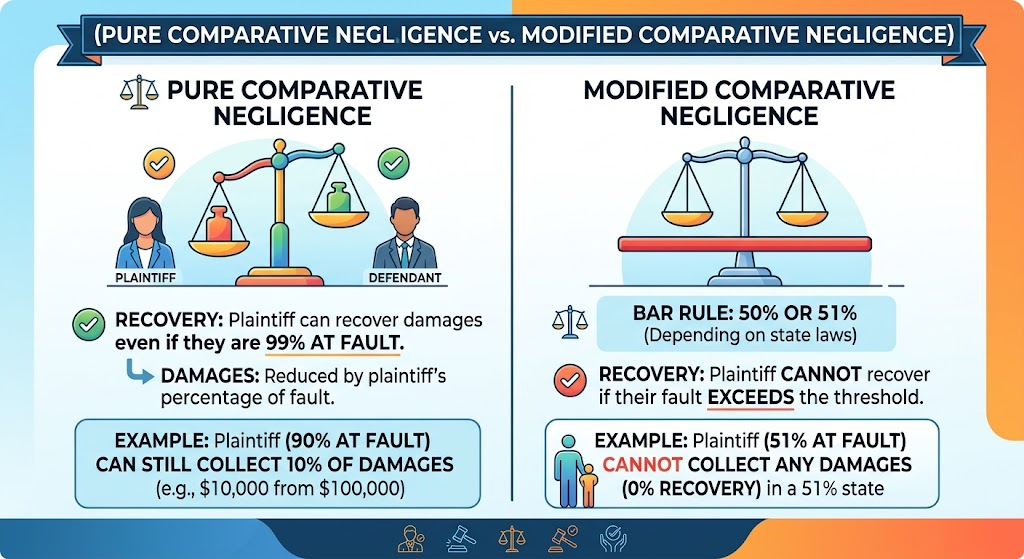
The key difference occurs when the percentage of fault of the injured party is a significant one. In the former case, the individual would normally be able to recover whatever part of the damages is not attributable to them, even though their percentage is higher than that of the other side.
In the latter case, recovery would normally be impossible for anyone who hits the statutory bar, which could be anywhere from a 50 or 51% bar.
The practical difference can be illustrated through the following example:
| Rule | Effect of claimant’s fault | Basic illustration |
|---|---|---|
|
Pure comparative negligence
Most Favorable |
Recovery is reduced by the claimant’s percentage | 70% fault may leave 30% of proven damages |
|
Modified, 50% bar
Moderate Bar |
Recovery may be barred at 50% or more | 50% fault may prevent recovery |
|
Modified, 51% bar
Stricter Bar |
Recovery may be barred at 51% or more | 51% fault may prevent recovery |
|
Contributory negligence
Harshest Rule |
Any legally relevant claimant fault may bar recovery | Even a small share may be decisive |
This chart demonstrates the reason why the relevant state law needs to be considered early on in a case. The question of whether a shift occurs from 49% liability to 50% liability or from 50% liability to 51% liability will be quite differently answered depending on whether a modified or a pure system of negligence applies.
There may also be other provisions in state law, as well as state law exceptions, and so one cannot simply use the description without considering other information.
While a discussion of pure and modified negligence laws in a state-law guide will demonstrate how things work in general, it cannot take the place of legal guidance on the particular injury involved.
Comparative Negligence vs. Contributory Negligence

Comparative negligence vs contributory negligence is the term used for two entirely different methods of evaluating the plaintiff’s own conduct in causing an injury.
In general, comparative negligence systems calculate damages based on the degree of fault, but the effect of contributory negligence is that even partial contribution by the plaintiff in causing the injury will disentitle him from compensation.
Contributory negligence means that if the contribution by the plaintiff to the accident is established, it will act as a defense to the plaintiff’s action, depending on the relevant legal provisions and exceptions.
Comparative negligence means that the contribution of the plaintiff to the accident will influence the quantum of the award and not defeat the case altogether.
In addition to this, I would also differentiate between the law and the position that an insurer will take during negotiations. An insurer might talk about a case assuming that it will come to an end if there is even one mistake, while according to the legal rule, there must be a proportionate reduction. Similarly, the claimant might think that he or she will always recover in a pure system while even then, evidence of fault and damages is needed.
| Comparative Negligence | Contributory Negligence | |
|---|---|---|
| Effect of fault | Reduces the award by your share of fault | Can bar recovery entirely, even for minor fault |
| Can you still recover? | Usually yes, at a reduced amount | Often no, if any fault is proven |
| Where it applies | Most states, in pure or modified form | A small number of states |
How Insurance Companies Use Comparative Fault Against You
An insurance claims adjuster may review any fact that could support assigning part of the liability to the injured person. This may include an early statement, a social media post, a gap in medical treatment, disputed traffic details, or changes in the account of what happened.
This could be a statement made early in the process, a post made on social media, a treatment gap, a disputed traffic detail, or an evolving story due to new information. The important thing is not whether the adjuster asks about the liability but how the reply will be interpreted in the future during settlement negotiations.
If the insurer denies the claim or argues that your own conduct completely prevents recovery, ask for the reason in writing and preserve the supporting documents. You may also need to understand what to do if the insurance company denies your injury claim, particularly when the denial is based on disputed fault, insufficient evidence, or an alleged policy issue.
My communication will be factual, concise, and in line with what is known. Photographs, medical documentation, bills, income details, and messages will be preserved instead of presuming the insurance company already has them.
My communication will be factual, concise, and in line with what is known. Photographs, medical documentation, bills, income details, and messages will be preserved instead of presuming that the insurance company has all of this information.
Should assistance in finding the right lawyer be required, LawyerHelpNow offers the option, although the validity of the case will still rest on facts and law.
How to Protect Your Settlement Under Pure Comparative Negligence

Settlement defense requires viewing fault as a question that should have evidence. In this case, I would document what took place while the facts were still fresh, keep the original pictures and messages and also follow medical instructions.
I would refrain from speculating about the case during questioning and would also be able to tell apart my personal observations from those of other people.
An organized file makes the claims easy to review. In my case, I would organize the documents according to the event, medical care, and financial impact rather than submitting random documents whenever they are asked for.
If the insurance company disputes fault or attempts to assign you an unfair percentage of responsibility, you may want to find a personal injury lawyer who can review the evidence, explain the applicable state law, and help you evaluate your legal options.
You should also confirm the deadline for filing a personal injury lawsuit before spending too much time negotiating with an insurance company. A statute of limitations calculator may provide an initial estimate, but the actual deadline depends on the state, type of claim, date of injury, and any applicable exceptions. The deadline should be confirmed with a qualified attorney.
Talk to Someone Who Can Help — Today
Available 24/7. Our intake specialists listen, help you understand your options, and connect you with the right attorney at no cost.
Frequently Asked Questions
Can I recover damages if I was partly at fault?
Possibly. In a pure comparative negligence jurisdiction, damages are generally reduced by the claimant’s assigned percentage of fault, though the claim still requires proof of liability, causation, and damages.
What does pure comparative fault mean?
Pure comparative fault means a claimant may generally recover the portion of damages attributed to other responsible parties, even when the claimant bears a substantial share of the blame.
How is my percentage of fault determined?
A court or jury may consider testimony, photographs, records, physical evidence, expert opinions, and the conduct of each involved party. The exact process varies by jurisdiction and claim type.
What is the difference between pure and modified comparative negligence?
Pure comparative negligence generally reduces recovery in proportion to the claimant’s fault. Modified comparative negligence may bar recovery once the claimant reaches a statutory fault threshold.
Is contributory negligence the same as comparative negligence?
No. Contributory negligence can bar recovery when the claimant’s negligence contributed to the injury, while comparative negligence generally adjusts recovery according to the claimant’s percentage of fault.
Can an insurer assign my fault by itself?
An insurer can propose a fault assessment during claim handling, but that proposal is not necessarily a final legal determination. The evidence and governing law control whether the assessment is defensible.
Should I accept a settlement that reduces my damages for fault?
Before accepting, I would review the evidence supporting the reduction, the value of the claimed losses, the release language, and any deadlines with a qualified attorney familiar with the applicable state law.