


Introduction
Not every denial or delay from your insurer is illegal but some cross the line. A bad faith lawsuit holds an insurance company accountable when it handles a valid claim unreasonably, dishonestly, or without a real investigation behind its decision.
Key Takeaways
A bad faith lawsuit may be available when an insurer handles a valid claim unreasonably or dishonestly. The details depend on the policy, evidence, and law of the state where the dispute arises.
- Bad faith is different from a simple disagreement over claim value.
- Denials, delays, low offers, and inadequate investigations may support a claim.
- Policy language, claim records, and communications are often central evidence.
- State law controls available remedies, deadlines, and required procedures.
- Early legal guidance can help preserve evidence and assess next steps.
What Is a Bad Faith Lawsuit?

A bad faith claim is a lawsuit that an individual files against an insurance company for acting negligently in dealing with an insurance obligation.
In my experience, I consider this to be not just a simple oversight or misunderstanding but something that can be unreasonable, unreasonable, or unjustifiable based on the terms of the contract. The policy holder can choose to make the claim along with a breach of contract action, depending on the laws of the state.
The underlying dispute could be related to a homeowner’s policy, automobile policy, life insurance policy, health insurance policy, business insurance policy or liability insurance policy. Some of the allegations made in a bad faith suit include unreasonable denial of coverage without
justification, unreasonable delay in paying claims without cause and failure to properly investigate the matter.
I would consider what the contract says, what evidence the insurance company had, how the insurance company handled the matter, and whether their reasons changed.
It will depend on the legal requirements of each state as to how they will view these actions. A good case usually needs more than just dissatisfaction with the insurance companies position.
I would consider what the contract says, what evidence the insurance company had, how the insurance company handled the matter and whether their reasons changed.
What Qualifies as Bad Faith by an Insurance Company?

Insurance carriers may investigate a claim, demand documents, and issue their decision. An insurance claims adjuster may be responsible for reviewing the claim, gathering information, evaluating the policy, and communicating the insurer’s position.
Understanding the claims-adjustment process can help a policyholder distinguish between ordinary claim handling and conduct that may raise bad faith concerns.
The following actions can give rise to concerns, but none of them alone constitutes bad faith. The state law involved, the wording of the policy, the available evidence, and the motives of the insurance carrier are relevant factors. A checklist of insurance bad faith indicators will provide some structure for a discussion of such concerns.
Unreasonable Denial of a Valid Claim
The insurance company acts wrongly when it refuses claims covered under its policies based on insufficient factual and legal basis. In the denial letter, the language in the policy, along with facts that justify the decision, should be clearly stated.
If the insurer’s stated reason does not match the policy language or appears to ignore important evidence, keep the denial letter and supporting documents for review. You can also learn more about what to do if an insurance claim is denied and the steps that may be available before considering litigation.
Delaying Payment Without a Legitimate Reason
In case the insurer has all the information required but still keeps on requesting extension of time to respond, the delay will become more worrisome. Delays vary according to jurisdictions and type of insurance involved. A chronology of notice, calls, requests, and responses will provide an idea of whether the delay was routine or unreasonable.
Offering a Settlement Far Below the Claim’s Value
The mere fact that a settlement is low does not necessarily mean that it is bad faith, as there might be disputes over the valuations involved. This becomes apparent when the offer does not take into account estimates, medical reports, repair records, and comparative figures that the insurer was supposed to take into account. In this case, I would compare the offer with policy limits, documented losses, and justifications for excluding parts of the claim.
I would compare the offer with policy limits, documented losses, and justifications for excluding parts of the claim. None of these actions alone constitutes bad faith — the full picture matters.
Failing to Investigate the Claim Properly
It would be normal for an insurer to investigate a claim in order to make a proper decision as to whether to deny it and how much it should pay. This could be achieved through reviewing the submitted documents, checking the damage, interviewing people, and responding to conflicting evidence.
Misrepresenting Policy Terms or Coverage
It may happen that misrepresentation of coverage occurs through inaccurate quotation of an exclusion, omission of the appropriate clause, or a policyholder is told that there is no such benefit while it is stated in the policy itself.
In any case, I would adhere to the terms and conditions of the policy and endorsements rather than to the explanation given orally. All the communications about the coverage can be kept for future reference.
Refusing to Defend a Covered Claim in Court
There might be cases when liability policies state that an insurance company has to defend the policyholder in court against particular suits. If the allegations appear to be covered by the policy, the refusal of defense will cause another issue in addition to the potential denial of the payment of the suit even if the company wins.
Canceling a Policy Without Proper Notice or Justification
However, a cancellation or non-renewal can become problematic if the insurer fails to follow proper notice requirements or provides an inappropriate cause for cancelling the policy. In such cases, notice timing, effective date, payment history, and cause for cancellation will be critical issues. It is a good idea to retain copies of the policy, billing statements, correspondence, and any notices received.
How to Prove Bad Faith Against an Insurance Company

In assessing a bad faith claim, it is necessary to look at the insurance policy, the claim file, and an account of what has occurred chronologically. The objective is to relate the behavior of the insurer to a certain responsibility that it had, which makes it unreasonable under those conditions. This record becomes particularly important if the insurer gives another reason for its decision later on.
The documents can consist of photographs, estimates, medical reports, expert witnesses’ opinions, transcripts of conversations, emails, claims information, letters of refusal, and documentation of damages sustained financially.
I would not delete any emails and would try to use written correspondence instead of phone calls. The insurer’s file might prove crucial, but it is the policyholder’s records that might give an account of what has happened prior to litigation.
I would not delete any emails and would try to use written correspondence instead of phone calls. I would also be careful not to overstate my case or withhold anything that could be unfavorable.
It is also important to determine the relevant deadlines, notice requirements, and any opportunities to cure before taking legal action. A statute of limitations calculator can provide an initial starting point for identifying a possible deadline, but the applicable deadline for a bad faith or contract claim should be confirmed under the law of the relevant state.
Here is an effective list of evidence to guide your investigation:
- The entire policy, including endorsements, declarations and renewal forms.
- All claims forms, estimates, photographs, receipts and medical records.
- A chronological account of all phone calls, letters, inspections, notices and responses.
- Any denial, reservation of rights, cancellation or settlement documents.
- Proof of any losses, income losses, property damage or any other damages.
This list is not intended as legal advice, but it will make your first consultation more productive. I would also be careful not to overstate my case or withhold anything that could be unfavorable.
Bad Faith Insurance Laws by State
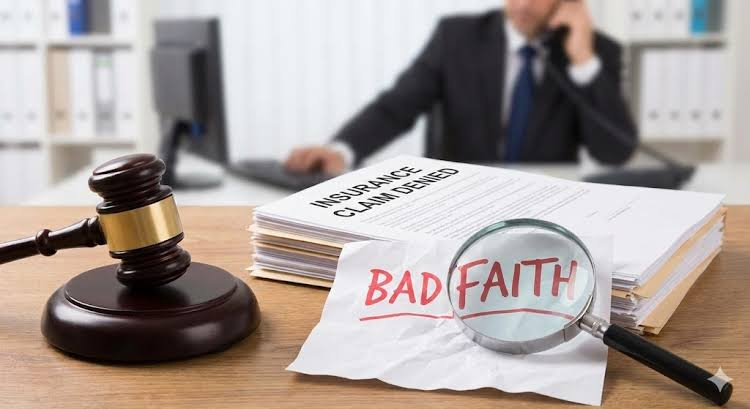
Bad faith law varies from state to state within the United States. Some states have claims based upon common law, other states have claims based upon statutes or consumer protection laws, and some states have claims based upon both. I would verify which law controls before assuming the rule in another state applies to my case.
The different states will likely vary with regard to the types of damages allowed, whether attorney fees can be recovered, any required notices, and the statute of limitations. Terminology may differ such that one state may emphasize unreasonable conduct whereas the other may need to prove a statutory violation.
Texas Bad Faith Insurance Laws — DTPA and Insurance Code
Texas disputes concerning insurance coverage may revolve around issues regarding the Texas Insurance Code and the Deceptive Trade Practices Act.
The issues may concern whether there was misrepresentation in the coverage, failure to conduct a proper investigation, and an unfair claim practices case. I would suggest the use of counsel to review the policy, statutory requirements, and any pre-suit notice requirement prior to filing.
An example based on comparison between states demonstrates:
| State | Common Legal Source or Issue | Point to Verify |
|---|---|---|
| Texas | Insurance Code and possible DTPA theories | Statutory requirements and notice |
| Florida | Section 624.155 and insurer conduct | Civil remedy notice procedure |
| California | Implied covenant and Brandt fees | Fee recovery tied to benefits dispute |
| New York | Contract and bad faith limitations | High threshold and applicable deadline |
These labels are only a map for further research. I would not assume that a Texas remedy, deadline, or damages theory carries over to another state.
Florida Bad Faith Insurance Laws — Section 624.155
Florida Statutes Chapter 624.155 is one that is generally recognized as dealing with a first party bad faith situation and the civil remedy notice procedure. The notice is one procedural step in the process that could very well impact the case in both timing and substance. It would be best if a Florida attorney were able to review the policy and the case and give advice as to the notice procedure.
California Bad Faith Insurance Laws — Brandt Fees
An implied covenant of good faith and fair dealing exists in California insurance laws. In some instances, it may be that a policyholder is entitled to recover his legal fees for seeking recovery of benefits that were due under the policy contract, and these are generally referred to as Brandt fees.
New York Bad Faith Insurance Laws and Limitations
Bad faith claims in New York may have a difficult hurdle to pass, especially where the claimant asserts that an insurance company has not properly settled or handled their claim. The facts, policy wording, and circumstances can all be dispositive.
It would make sense to see what the statute of limitations says and whether there is a distinction between a mere dispute over a contract and behavior that could constitute bad faith in New York.
How to Find Your State’s Specific Bad Faith Insurance Statute
A good place to begin would be the state insurance commission, the law that has been passed, and the policy itself, followed up on by consulting a lawyer who does bad faith insurance work in that area.
Because bad faith rules and insurance remedies vary by state, speaking with an attorney familiar with insurance disputes may help clarify the available options. Readers can also find a personal injury lawyer through LawyerHelpNow and request a case evaluation to discuss their situation. The state insurance rights handbook would be helpful in this regard.
Bad Faith Lawsuit vs. Regular Insurance Dispute — Key Differences
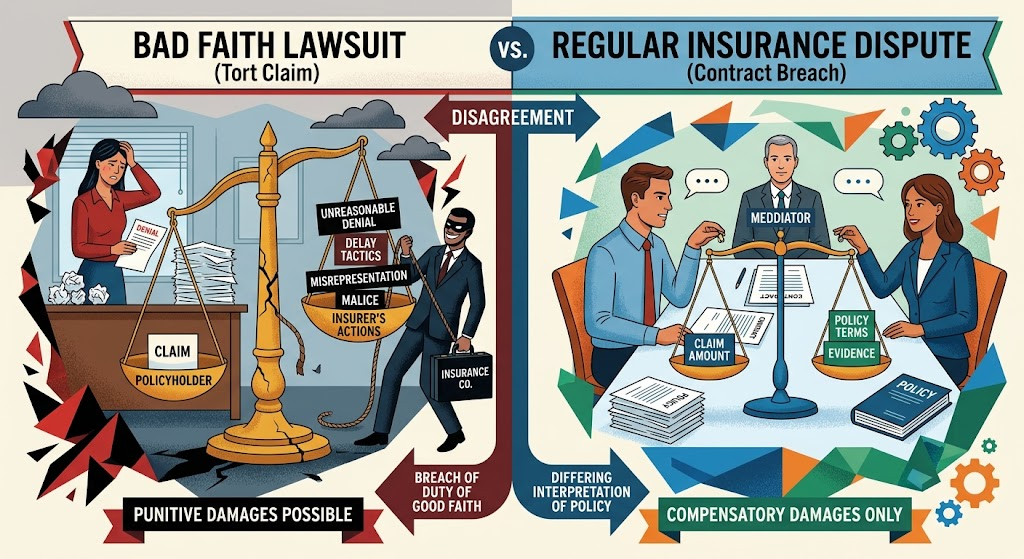
A typical insurance dispute usually revolves around an honest difference of opinion on matters of coverage, causation, valuation, or interpretation of policy language.
Bad faith claims, on the other hand, go beyond such a dispute by asserting that the way the insurer handled the matter was unreasonable or unfair. I would differentiate between the two because the proofs and potential remedies would vary.
The difference does not imply that the insurer should agree with every claim. The insurer is supposed to look at the claim objectively, interpret the policy correctly, communicate clearly and state his/her reasons for taking the position that he/she takes. A guide on the typical process flow of claims handling will enable me to analyze how the process flows.
| Comparison Point | Bad Faith Lawsuit | Regular Insurance Dispute |
|---|---|---|
| What It Involves | The insurer’s conduct itself becomes the legal claim | A disagreement over how much is owed under the policy |
| What Must Be Shown | The insurer acted unreasonably or without a legitimate basis | The claim is valid and covered under the policy terms |
| Who It’s Against | The insurance company for how it handled the claim | Usually resolved directly through negotiation or appeal |
| Possible Damages | Policy benefits plus additional damages, in some states | Generally limited to the amount owed under the policy |
| Typical Next Step | Often requires an attorney and formal legal action | May be resolved through appeal, mediation, or reconsideration |
I would also take into account the fact that the bad faith claim should have led to a compensable loss, as well as whether the claim was timely filed. Because an insurance dispute can involve significant legal and financial issues, some people may also want to understand how attorney fees work before seeking representation.
Depending on the case and attorney, a no-win-no-fee lawyer may handle certain personal injury matters through a contingency-fee arrangement, meaning the fee is generally tied to a successful recovery.
Dealing With an Insurer Acting in Bad Faith?
Our intake specialists are available 24/7 to listen, help you understand your options, and connect you with a qualified attorney at no cost.
Frequently Asked Questions
What is a bad faith lawsuit?
It is a legal claim alleging that an insurer handled a policy obligation unreasonably, unfairly, or dishonestly. The precise elements depend on state law and the policy involved.
Is every denied insurance claim bad faith?
No. An insurer may deny a claim for a legitimate reason supported by the policy and facts. Bad faith generally requires more than an incorrect decision or ordinary disagreement.
What evidence helps prove insurance bad faith?
Helpful evidence may include the policy, claim correspondence, denial letters, estimates, photographs, medical records, expert opinions, and a dated log of communications. The insurer’s reasons and investigation history are also important.
Can I sue for both breach of contract and bad faith?
Often, a policyholder may assert both theories, but the rules vary by state. A contract claim usually concerns benefits owed under the policy, while bad faith concerns the manner in which the insurer handled the obligation.
How long do I have to file a bad faith claim?
The deadline depends on the state, policy, claim type, and legal theory. Contract and statutory claims may have different limitation periods, so I would check promptly rather than rely on a general estimate.
Can an insurer be liable for refusing to defend me?
Potentially, if the policy created a duty to defend and the underlying allegations potentially fell within coverage. The duty to defend is separate from the duty to indemnify, and both require close review of the policy and lawsuit.
Should I speak with a lawyer before contacting my insurer?
I can continue complying with reasonable claim requests, but legal advice may help me preserve evidence, understand deadlines, and avoid statements that could be misunderstood. A lawyer can assess whether the dispute appears contractual, bad faith-related, or both.
Find Legal Help
If an insurer has denied, delayed, or undervalued my claim, I can use LawyerHelpNow to seek a free case evaluation and connect with an attorney for guidance on my situation.