


Introduction
After your insurer pays a claim, the story isn’t always over. Subrogation lets the insurer go after the party actually at fault and understanding how it works can help you protect your own settlement along the way.
Key Takeaways
Subrogation can feel technical, but the basic idea is straightforward: an insurer may seek repayment from the person or company responsible for a covered loss.
- Subrogation lets an insurer pursue a responsible third party after paying a claim.
- In an injury case, the process may involve health insurers, liability carriers, attorneys, and medical providers.
- Policy language, contracts, and state law can change how much may be recovered.
- You should not sign a settlement or release without understanding possible reimbursement claims.
- Keeping records and getting legal advice can help protect your recovery.
What Is Subrogation in Insurance?

Explaining what is subrogation in insurance usually starts with the basic idea: insurance company covers your losses and then demands the compensation from those who caused them. Insurance company does not try to collect money twice – it simply tries to get money back which were paid because someone else was liable for damages.
If another driver was responsible for an accident and your insurance company paid for vehicle repairs or other covered losses, the insurer may pursue the responsible driver or that driver’s insurance company to recover what it paid.
If the accident also resulted in injuries or a dispute over insurance coverage, speaking with a car accident lawyer may help you understand how the recovery and subrogation process could affect your claim.
Other payments that you have made may also play a role in subrogation case – such as your deductible in case of accident. Explaining subrogation process in the case of car accident may help to understand the process better.
I would prefer knowing all the lien and reimbursement claims prior to agreeing on the allocation of funds. The proceeds of a recovery are not always divided the same way in every situation.
How Does Subrogation Work in a Personal Injury Case?

In a personal injury lawsuit, subrogation normally starts after payment by an insurance company or benefits provider of any medical expenses related to the accident. In a personal injury case, subrogation may arise after an insurance company or benefits provider pays medical expenses related to an accident.
The responsible party might be another motorist, property owner, employer, or another party, while the payment could come from health insurance, medical payments coverage, or a workers’ compensation claim. When a workplace injury also involves a third party, the workers’ compensation system may have separate reimbursement or subrogation rules.
Normally, I would have expected exchange of information between the parties involved concerning medical bills, insurance payments, liability, and the amount of the settlement being negotiated.
Automobile claims can become more complicated when the at-fault driver has little or no insurance. In those situations, uninsured motorist coverage may provide another source of compensation, while the applicable policy and state law determine whether subrogation or reimbursement rights apply.
Types of Subrogation in Insurance

Subrogation arises out of various sources of law, and this is important because it might affect the rights of the insurer and the defense of the insured. Subrogation claims may originate from general legal principles, or the wording of the policy itself, or even the statute. The distinctions set out below are not always clear cut.
Equitable Subrogation
Equitable subrogation, being an extension of equity concepts, is not based on any express promise within the policy but may enable the party paying the loss to bring action against the party who actually should bear the loss.
Equitable subrogation being developed through case law, issues relating to double recovery, fault, notice, and conduct of the parties can be very important.
However, I would not expect that making a payment by the insurer automatically brings success for an equitable claim. The insurer normally has to relate his payment to some legally recoverable loss and to explain the reason why it would be equitable to shift the cost in this particular case.
Contractual Subrogation
Contractual subrogation is founded upon language included in an insurance contract, health care plan, loan contract, or some other type of contract. Such a contract can call for cooperation, notice of a settlement, repayment out of proceeds, or consent prior to any settlement being reached. Waiver of subrogation could also be an issue.
I would refer to the actual language of the contract and not take someone else’s description of that language. Definitions, exclusions, priority provisions, or even reimbursement formulas can all impact the outcome. A contractual case can only be as good as the contract language and law itself.
Statutory Subrogation
Statutory subrogation arises out of or is restricted by statutes. Workers’ compensation statutes, benefit statutes, and insurance statutes can provide guidelines for notice, approval of settlements, allocation, or reimbursement.
Some statutes will give a direct right of recovery to the carrier, whereas some other statutes may impose restrictions on the recovery in order to protect the recovery of the injured individual.
Such guidelines become extremely relevant in those cases where the settlement is relatively small in comparison to the entire medical cost. I would check the relevant statute along with the case law before making the conclusion that the claim has to be settled in its totality.
Hospital and Medical Subrogation
This can arise from a scenario whereby a health insurance policy or medical payment coverage pays for treatment after an injury. The health plan can then request reimbursement for its part from a settlement on the liable party.
An illustration by Health Advantage states that healthcare expenses might be reimbursed from the insurance company of the liable party, ensuring healthcare expenses get covered without waiting for the end of the liability claim.
A medical reimbursement claim needs to correspond to bills and payments incurred as a result of the accident. I would require an itemized account of the same, the language of the plan, and reasons why the deductions or charges have been made. An administrator in the plan may process this claim, with Equian|Trover Solutions, Inc. being the partner firm doing so for Health Advantage.
How to Protect Yourself From Subrogation Claims

Expensive. My preferred way is to regard any communication from insurers as part of the injury or property loss case file, and not just another piece of correspondence. Proper planning will help find contradictions in the payment history and avoid inadvertent release.
If I were to handle a case, I would follow these tips:
- Save all the explanations of benefits, medical bills, policy notices, settlements and correspondence.
- Let my lawyer and insurers know if there is any other insurance covering the loss.
- Never sign a release mentioning liens, reimbursement and subrogation without understanding it.
- Request a payment history and basis of the demand from the payer.
- Maintain a separate record of all deductibles, co-payments, lost income and other uninsured losses.
My preferred way is to regard any communication from insurers as part of the injury or property loss case file, and not just another piece of correspondence.
The above-mentioned checklist cannot be considered as legal advice, but provides a good paper trail. I would also report settlement negotiations in timely manner if the contract requires it. In case of difficulties, I can ask for a free case evaluation.
Subrogation in Insurance — State by State Rules

The law regarding subrogation does vary from state to state. One state will handle reimbursement laws in different ways for auto insurance, health care plans, workers’ compensation, governmental benefits, and legal fees. The answers within one state could even vary based upon the nature of the coverage and language in the policy.
These examples from the states are only a starting place; not an exhaustive legal explanation of the issue. I would use these examples to determine the issues that must be addressed, then check the existing law through an appropriate lawyer or agency. The timing of claims, notice required, lien restrictions, and settlement procedures may all matter.
Texas Subrogation Laws and Protections
The Texas law subrogation depends on the kind of claim, the nature of the contract, and whether the party paying the money has the legal right to be reimbursed. It may involve settlement of claims under a health care plan, workers’ compensation, or where there is insurance money paid out for property or health care expenses.
Questions to ask here would include if notice was given within the period required by Texas law and if the amount demanded is related to covered expenses incurred due to an accident. Texas law can also look at equitable considerations and how attorney fees affect the claim.
I would use these examples to determine the issues that must be addressed, then check the existing law through an appropriate lawyer or agency.
Florida Subrogation Laws and Protections
Floridian claims may arise out of reimbursements sought by health insurers, benefit plans, automobile insurers, or workers’ compensation programs. Whether the source of the claim is important, as well as the terms of the policy and the nature of the connection between the settlement and the payment of expenses.
It is important to me to know whether the amount being claimed includes treatment that is unrelated or charges that have never been paid. It is also important for me to learn whether there is any statutory process that needs to be followed prior to distribution of the settlement.
California Subrogation Laws and Protections
Typical issues regarding subrogation in California often involve the need to pay close attention to policy wording, health care plan terms, and the distribution of personal injury settlement proceeds. There may be disagreements about the existence of the plan’s right of reimbursement or whether the demand should be decreased.
In my opinion, the complete wording of the plan should be used rather than just an insurance card or a description of the plan. The California laws also sometimes relate to attorney fee agreements and the limitation of liability of the injured party.
New York Subrogation Laws and Protections
In New York, the subrogation cases may relate to the no-fault insurance, health insurance, workers’ compensation or recovery of money from liable third parties. Since each type has different rules and restrictions, the name written on the envelope does not necessarily define all the details about the subrogation.
I would request the legal basis for the claim, the book of payments and any notices. The terms of the agreement must be examined against the demands for repayment prior to accepting the money.
How to Find Your State’s Specific Subrogation Rules
This is where I would begin: the policy, the plan document, and all correspondence related to the reimbursement process. After that, I would determine the source of the payment, the nature of the accident, the state in which the claim has originated, and any existing lawsuits or settlements.
The following questions may serve as a guide to my research:
| Question | Why It Matters |
|---|---|
| Who paid the original bill? | The payer may have different rights depending on the coverage type. |
| What document creates the claim? | A policy, plan, statute, or court doctrine may control. |
| What state law applies? | Notice, allocation, and repayment rules vary by jurisdiction. |
| Has a settlement or release been signed? | Existing language may affect future recovery rights. |
Deadlines may also differ depending on whether the issue involves a personal injury lawsuit, an insurance claim, a contract-based reimbursement right, or a statutory subrogation claim. A statute of limitations calculator can provide an initial reference point, but the applicable deadline should be confirmed under the law governing the specific claim.
Subrogation vs. Indemnification — What Is the Difference?
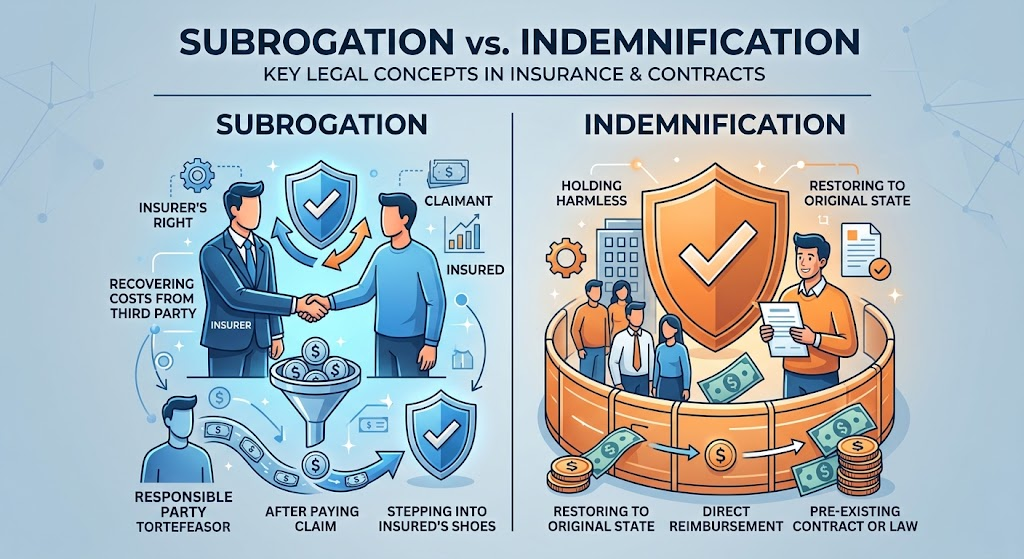
Indemnification is usually associated with compensation of losses or liabilities according to a specific contract. The insurance is created to indemnify the insured in case of any loss, within the limits, exceptions, and conditions of the insurance policy. Subrogation occurs after that or simultaneously with such indemnification to give the right of recovering funds from the liable party.
In simple words, indemnification is the payment to the insured under the agreement, whereas subrogation is the shift of costs to the responsible party. They are related terms but cannot be used interchangeably. Someone may have an indemnity payment for a certain loss but have further questions regarding the rights of the insurer to recover.
These issues need to be considered during a contract analysis. In my view, I should analyze who is responsible for paying, who pays first, which documents regulate these payments, and whether the loss is calculated twice.
| Comparison Point | Subrogation | Indemnification |
|---|---|---|
| What It Is | The right of a payer to recover what it paid from the at-fault party | The obligation to compensate someone for a loss they suffered |
| Who Acts | An insurer or other payer steps into the injured party’s shoes | One party directly pays or reimburses the other |
| Direction of Recovery | Payer recovers funds from a third party who caused the loss | Party responsible for the loss pays the affected party |
| Common Example | Health insurer seeking repayment from a settlement | An at-fault driver’s insurer paying for the other driver’s damages |
| Why It Matters to You | May reduce your net settlement through a reimbursement claim | May determine who is ultimately responsible for paying a loss |
Get Help With Your Claim
If a subrogation or reimbursement claim is affecting an injury settlement, LawyerHelpNow can help you find an attorney and request a free case evaluation.
Depending on the type of case and the attorney’s fee agreement, a no-win-no-fee lawyer may handle certain personal injury matters through a contingency-fee arrangement. Review the fee agreement carefully so you understand how attorney fees, case expenses, and reimbursement claims may affect your final recovery.
Facing a Subrogation Claim on Your Settlement?
Our intake specialists are available 24/7 to listen, help you understand your options, and connect you with a qualified attorney at no cost.
Frequently Asked Questions
What does subrogation mean in insurance?
Subrogation means an insurer or benefit provider may seek repayment from a third party responsible for a loss after paying covered expenses.
Does subrogation mean I owe my insurance company money?
Not necessarily. The insurer may pursue the responsible party or that party’s insurer, but you may need to cooperate and protect the insurer’s rights under your policy or plan.
Can subrogation reduce my settlement?
It can, depending on the governing contract, state law, the amount paid, and whether the claim is valid. A negotiated reduction may sometimes be possible.
What should I do after receiving a subrogation letter?
Read it carefully, keep a copy, notify your attorney if you have one, and request the documents supporting the claimed amount before agreeing to repayment.
Can I ignore a subrogation notice?
Ignoring it can create problems, especially if your policy or plan requires cooperation or notice. Responding does not mean accepting the claim, but it helps preserve your options.
Does every insurance claim involve subrogation?
No. Subrogation usually requires a possible responsible third party and a payment that another insurer or benefit provider may legally seek to recover.
Should I hire a lawyer for a subrogation dispute?
Legal advice can be useful when the amount is significant, liability is disputed, a settlement is pending, or the reimbursement claim involves complex plan or state-law rules.