
What to Do If You’re Injured as a Passenger in a Car Accident in Texas
If you were injured as a passenger in a Texas car accident, you may have a claim even though you were not driving. The potentially responsible party could be another driver, the person transporting you, an employer, a rideshare or delivery company, a vehicle owner, or another entity. The correct answer depends on the crash facts, the insurance policies, and the evidence connecting the collision to your injuries.
⚠️ Important Legal & Medical Notice
- This guide is for educational purposes only, not legal or medical advice.
- Call 911 immediately in a medical emergency.
- Texas laws, deadlines, and insurance policies vary by case.
- Consult a licensed Texas attorney for legal advice specific to your situation.
Quick Answer: What Should an Injured Passenger Do After a Texas Car Accident?
Call 911 when anyone may be injured, accept appropriate medical care, and move away from traffic only when it is safe. If your condition allows, collect the drivers’ insurance information, witness details, vehicle information, photographs, and the investigating officer’s report number. Preserve medical and income records, identify every potentially responsible party and policy, and avoid signing a settlement release before the nature of your injuries and future needs are reasonably understood.
Key Takeaways
- Protect your health first. Seek emergency or follow-up care when symptoms are serious, new, or worsening.
- Preserve the crash record. Save photographs, witness information, insurance details, medical records, and the Texas Peace Officer’s Crash Report when available.
- Look beyond one driver. More than one driver, company, vehicle owner, or insurance policy may be involved.
- Review first-party coverage. PIP, MedPay, UM/UIM, health insurance, and commercial or rideshare coverage may help even while fault is disputed.
- Do not rush a release. A signed settlement release can close the claim even if symptoms or treatment needs later become more serious.
Texas Road Safety Snapshot
Official TxDOT data shows why prompt medical care and evidence preservation matter. These figures describe all reportable motor vehicle traffic crashes in Texas, not only passenger injury claims, but they provide current statewide context for the scale of the problem.
📊 Official Texas Traffic Crash Statistics (2025)
| Statistic | TxDOT Report |
|---|---|
| Traffic Deaths | 4,150 deaths (3.29% lower than 2024) |
| People Injured | 251,977 people injured in motor vehicle crashes |
| Serious-Injury Crashes | 14,905 crashes involving 18,218 seriously injured people |
| Crash Frequency | One reportable crash every 57 seconds |
TxDOT also reported no deathless day on Texas roadways in 2025. Statistics cannot determine the value or outcome of an individual claim, but they support a careful, evidence-based approach after any collision.
Immediate Steps After a Texas Passenger Car Accident
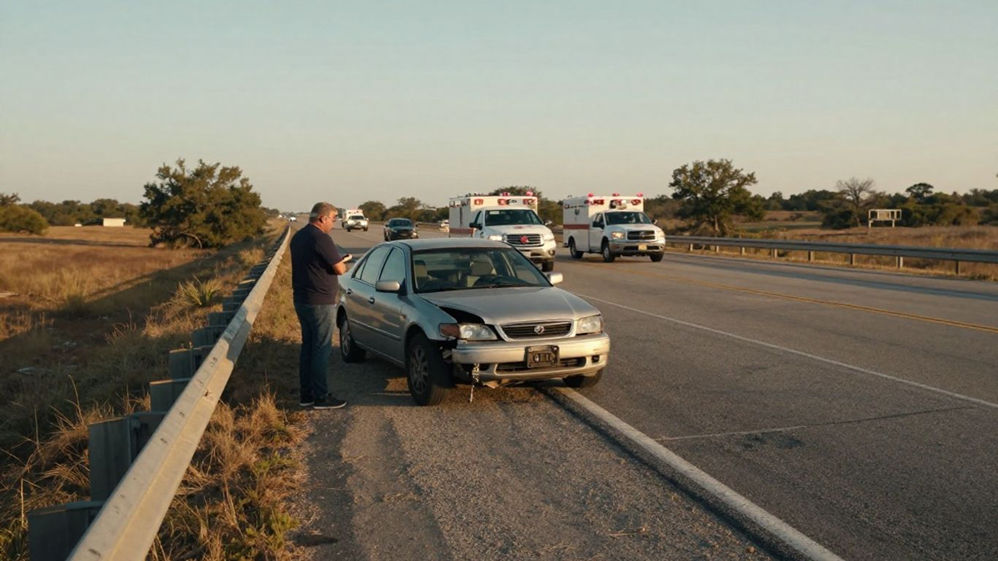
The first minutes after a crash are often disorienting. A passenger does not need to solve fault at the scene. Focus on safety, medical care, and preserving information only when your physical condition allows.
1. Check for Injuries, Call 911, and Move Only If It Is Safe
Call 911 when anyone may be injured, trapped, unconscious, bleeding, confused, or having difficulty breathing. Give the dispatcher the location and a factual description of the emergency. Do not move a person who may have a serious head, neck, or back injury unless an immediate danger, such as fire or moving traffic, makes remaining in place more dangerous.
2. Get the Drivers’ and Witnesses’ Information
If you are physically able, record the names, phone numbers, driver’s license details, license plates, vehicle descriptions, and insurance information for every involved driver. Photograph insurance cards when possible. Ask independent witnesses for their names and contact information before they leave.
3. Photograph the Scene and Preserve Time-Sensitive Evidence
From a safe location, photograph vehicle positions, damage points, the roadway, traffic controls, debris, skid marks, weather, lighting, visible injuries, and anything else that may explain how the crash occurred. Note nearby businesses, homes, dashcams, or traffic cameras because video may be overwritten quickly.
4. Seek Medical Evaluation and Follow the Treatment Plan
Some injuries are obvious immediately, while headache, neck stiffness, back pain, dizziness, numbness, or reduced movement may appear or worsen later. A prompt evaluation allows a qualified medical provider to assess your condition and document when symptoms began. Follow reasonable instructions, attend appointments, and report meaningful changes accurately.

5. Report the Crash and Obtain the Texas CR-3 Report
Ask for the investigating officer’s name, agency, badge number, and incident or report number. When the report becomes available, review basic facts such as names, vehicles, passenger position, insurance details, location, and the reported sequence of events. A crash report is important evidence, but it does not automatically decide every issue of fault or damages.
A passenger directly involved in the crash generally qualifies to request a Texas Peace Officer’s Crash Report through the TxDOT Crash Report Online Purchase System. TxDOT currently lists a regular copy at $6 and a certified copy at $8, plus possible processing fees. A certified copy may be useful in a legal proceeding.
What If You Are Too Injured to Collect Evidence?
Do not risk worsening an injury to create a perfect evidence file. A trusted person may be able to preserve clothing and personal items, photograph visible injuries and vehicle damage, collect discharge paperwork, write down what you remember, and obtain the crash report. Treatment takes priority.
A Practical Timeline for the First Days After the Crash
The order of events matters. The following timeline keeps the focus on health, evidence, and avoiding preventable claim problems. It is a practical checklist, not a substitute for legal or medical advice.
📋 Passenger Injury Claim Timeline
| Time Period | Priority Actions | Main Risk to Avoid |
|---|---|---|
| At the Scene | Call 911, accept medical care, gather driver and witness details, take photos, and get the police report number. | Avoid entering traffic, arguing about fault, or refusing medical attention. |
| First 24-72 Hours | Follow up with medical care, notify insurers, save records, document what happened, and identify available video evidence. | Avoid making speculative statements or losing important evidence. |
| First 1-2 Weeks | Obtain the CR-3 report, organize medical and wage records, verify insurance coverage, and track symptoms. | Don’t assume only one insurance policy may provide coverage. |
| Before Any Settlement | Review your diagnosis, future treatment, lost wages, policy limits, and all parties involved. | Avoid signing a release before understanding your full losses. |
Who May Be Liable for a Passenger’s Injuries in Texas?
Liability depends on the conduct that caused or contributed to the crash, not simply on the vehicle in which the passenger was sitting. A complete investigation may identify one driver, several drivers, or an additional person or company.
The Driver of Another Vehicle
Another driver may be responsible for speeding, following too closely, failing to yield, running a traffic signal, making an unsafe lane change, driving while distracted or impaired, or committing another unsafe act. That driver’s bodily injury liability coverage is often the first policy considered.
The Driver of the Vehicle You Were Riding In
The driver who was transporting you may also be responsible if that driver caused or contributed to the collision. This can feel uncomfortable when the driver is a friend or relative, but the legal and insurance analysis should follow the evidence. Household exclusions, resident-relative definitions, and other policy terms can affect coverage, so the full policy matters.
More Than One Driver
Responsibility may be divided in an intersection, chain-reaction, or multi-vehicle crash. Texas proportionate responsibility law generally bars a claimant from recovering if the claimant’s own percentage of responsibility is greater than 50 percent. When recovery is allowed, damages can be reduced by the claimant’s percentage of responsibility. Passengers often have little or no role in causing a collision, but unusual conduct can still be raised as a fact-specific defense.
Other Potentially Responsible Parties
An employer may be relevant when a driver was acting within the course and scope of work. Other cases may involve a rideshare or delivery company, vehicle owner, maintenance provider, manufacturer, alcohol provider, contractor, or governmental unit. Rideshare coverage can change depending on whether the driver was offline, available for a trip, en route to a passenger, or transporting a passenger. Commercial and governmental claims may require faster evidence preservation and special notice procedures.
How Texas Fault Rules Affect an Injured Passenger
Texas is a fault-based state for automobile liability claims. The injured passenger generally seeks compensation from the person or entity whose negligence caused the harm. Texas is not a broad no-fault state, but first-party benefits such as PIP can be payable without regard to fault. The practical questions are who caused the crash, what losses can be proved, and which policies define the passenger as an insured or covered person.
Which Insurance Policies May Cover an Injured Passenger?

A passenger should not assume that only the at-fault driver’s policy matters. Coverage may come from the vehicle the passenger occupied, another involved vehicle, the passenger’s own policy, a household policy, health insurance, or a commercial or rideshare policy.
Obtain declarations pages and the relevant policy language whenever possible. The declarations page shows listed limits, but the policy defines who is covered, what exclusions apply, and what conditions must be satisfied.
🛡️ Insurance Coverage Options for Injured Passengers in Texas
| Coverage | What it may address | Texas-specific fact | Key limitation |
|---|---|---|---|
| At-fault liability | Medical expenses, income loss, pain, impairment, and other supported damages | Texas minimum liability limits are 30/60/25: $30,000 per injured person, $60,000 per accident, and $25,000 property damage | Fault, exclusions, damages, and policy limits must be established; the per-accident limit can be shared among multiple injured people |
| PIP | Reasonable covered medical and funeral expenses, income loss, and essential-service expenses | Texas policies must include PIP unless rejected in writing; the statutory minimum required offer is $2,500 per person; benefits are payable without regard to fault | Only covered expenses and losses up to the purchased limit; expenses generally must be incurred within three years; an offset may apply to a claim against the owner or driver of the occupied vehicle |
| MedPay | Covered medical expenses for occupants | Optional coverage that differs from PIP | Policy terms control; it does not provide the same wage-loss or essential-service benefits as PIP |
| UM/UIM | Damages caused by an uninsured or underinsured driver | Insurers must offer the coverage unless it is rejected in writing | The passenger must qualify as an insured; policy conditions apply; an unknown hit-and-run vehicle generally requires actual physical contact |
| Health insurance | Medical treatment while liability claims are pending | Can be used before fault is resolved | Deductibles, copays, liens, reimbursement, or subrogation issues may affect the final recovery |
| Commercial or rideshare | Injuries involving work vehicles, taxis, buses, delivery vehicles, or active rideshare trips | Coverage can change with the driver’s work and app status | Multiple policies, exclusions, and priority-of-coverage disputes may apply |
The minimum 30/60 bodily injury limits can be exhausted quickly when several occupants are hurt. Texas PIP law also contains technical rules that deserve attention. Covered expenses generally must arise from the accident and be incurred within three years, and benefits are payable without regard to fault. The statute requires payment no later than 30 days after the insurer receives satisfactory proof of a claim, subject to policy conditions and the statutory limits.
📋 Coverage Review Checklist
Ask for the declarations page, PIP selection or rejection, UM/UIM selection or rejection, all applicable endorsements, the complete policy, claim numbers, reservation-of-rights or denial letters, and any commercial or rideshare policy information. Do not rely only on an adjuster’s verbal summary.
How to Build and Document a Passenger Injury Claim
A well-organized claim connects the crash, the responsible conduct, the injury, the medical treatment, and the financial or personal effects. Collecting documents is only the first step. Keep a simple dated timeline showing what each record proves and where it came from.
Preserve Crash and Liability Evidence
Keep the CR-3 report, original photographs and videos, witness information, dispatch or incident numbers, towing records, repair or total-loss documents, and communications with drivers or insurers. Save original digital files rather than edited copies because dates and metadata can be useful. Record the location of any business, apartment, toll-road, traffic-camera, or dashcam footage promptly.
Create a Complete Medical File
Keep emergency records, physician notes, imaging reports, therapy records, prescriptions, referrals, invoices, explanation-of-benefits statements, and written work restrictions. Provide an accurate history to each treating provider, including when symptoms began and how they changed. Do not exaggerate or minimize. A preexisting condition does not automatically end a claim, but the evidence must distinguish the prior condition from any crash-related aggravation.
Document Lost Income and Daily Limitations
Save pay stubs, employer verification, attendance records, leave records, tax documents when relevant, and written medical restrictions. A self-employed passenger may need invoices, contracts, schedules, bank records, or other evidence showing reasonably lost income. A brief factual journal can record sleep disruption, mobility limits, missed family responsibilities, transportation problems, and activities you cannot perform.
Use an Evidence Checklist Without Letting It Replace the Facts
A checklist prevents missing records, but every item should have a clear purpose. Start with the core categories below and add documents that are specific to the crash and injuries.
- Crash report, incident number, officer details, scene photographs, dashcam files, and witness information.
- Names, contact details, insurance information, vehicle details, and employer or rideshare information for each driver.
- Medical records, bills, prescriptions, referrals, restrictions, and travel expenses for treatment.
- Pay records, employer letters, self-employment documents, and proof of out-of-pocket losses.
- Claim numbers, coverage letters, settlement offers, medical authorizations, releases, and adjuster communications.
- A backup copy of original digital files organized by date or evidence category.
What Compensation May Be Available to an Injured Passenger?
There is no reliable fixed or average settlement for a Texas passenger injury claim. Case value depends on the liability evidence, nature and duration of the injuries, treatment needs, preexisting conditions, income effects, daily limitations, insurance limits, liens, and whether the parties dispute causation or damages.
For broader context on why averages can mislead, review the guide to personal injury settlement amounts. The following categories may be recoverable when supported by the facts and applicable law.
- Past and future medical expenses. This may include reasonable and necessary treatment connected to the collision, subject to proof and Texas rules governing recoverable medical expenses.
- Lost wages and reduced earning capacity. A claim may include income already lost and, when supported, a reduction in future earning ability.
- Physical pain and mental anguish. These non-economic damages require evidence of the nature, duration, and effect of the injuries.
- Physical impairment or disfigurement. Serious injuries may produce limitations or visible changes that are distinct from medical expenses alone.
- Damaged personal property and out-of-pocket costs. A passenger may have damaged electronics, clothing, luggage, child seats, or reasonable transportation and care expenses.
- Wrongful death and survival damages. When a passenger dies, eligible family members or the estate may have separate claims under Texas law.
What Usually Drives Claim Value?
The number of medical bills alone does not determine value. Insurers and courts examine how the evidence fits together, including causation, treatment, function, credibility, and available coverage.
💰 Factors That Can Affect a Passenger Injury Claim
| Factor | Why it matters |
|---|---|
| Liability evidence | Clear video, witnesses, admissions, physical evidence, and consistent reports can reduce fault disputes. |
| Injury severity and duration | Fractures, surgery, brain or spinal injuries, permanent impairment, and long recovery periods often create greater documented loss. |
| Medical consistency | Prompt, reasonable treatment and accurate histories help connect the crash to the claimed condition. |
| Income and functional impact | Verified missed work, restrictions, reduced capacity, and concrete daily limitations show practical consequences. |
| Insurance limits and number of claimants | Even serious damages can exceed available coverage, especially when multiple passengers share a per-accident limit. |
| Liens and reimbursement claims | Health plans, medical providers, or benefit programs may claim part of a settlement and affect the net recovery. |
A settlement should be evaluated only after considering future medical needs, liens, reimbursement claims, attorney fees and case expenses, and the exact people or entities protected by the release.
Mistakes Injured Passengers Should Avoid
Claim problems often develop through a series of small decisions rather than one dramatic error. The following mistakes can affect medical proof, coverage, credibility, or the ability to recover.
- Delaying reasonable medical care. Delay can affect health and make it harder to explain when symptoms began or why treatment became necessary.
- Guessing about fault or crash mechanics. State only what you observed. Do not estimate speed, phone use, distance, or impairment without a factual basis.
- Posting about the crash or recovery on social media. Photographs, comments, check-ins, and private messages may be requested or used without the context you intended.
- Giving a detailed recorded statement to another party’s insurer without understanding the purpose. Ask who the adjuster represents and what information is actually required. Your own insurer may have cooperation duties under the policy.
- Signing a broad medical authorization. An authorization may permit access to records far beyond the treatment related to the crash.
- Accepting an early settlement before the medical picture is clear. A release usually prevents further recovery for the same claim.
- Assuming the obvious driver’s policy is the only coverage. PIP, MedPay, UM/UIM, household, commercial, employer, rideshare, and health coverage may also require review.
- Waiting until the deadline is close. Evidence may disappear, and special notice or policy requirements can expire long before the ordinary lawsuit deadline.
How Long Does a Passenger Have to File a Texas Car Accident Lawsuit?
Texas generally requires a personal injury lawsuit to be filed no later than two years after the cause of action accrues, which is often the crash date. Waiting nearly two years to investigate is risky because video, witnesses, vehicles, and records may become unavailable. Exceptions and tolling rules can change the calculation.
Claims involving a governmental unit can require notice much earlier. The Texas Tort Claims Act generally gives a governmental unit a right to notice no later than six months after the incident, but a city charter or other law may impose a different or shorter requirement. Insurance policies can also contain separate notice, proof-of-loss, cooperation, consent, or limitation provisions.
⏳ Important Texas Deadlines & Evidence Timeline
| Issue | General Texas rule or practical window | Why immediate review matters |
|---|---|---|
| Personal injury lawsuit | Generally two years after the claim accrues, often the crash date. | Exceptions, minority, incapacity, discovery issues, or other rules can change the date. |
| Governmental unit notice | Texas Tort Claims Act generally requires notice no later than six months; local rules can be shorter or different. | Missing notice can affect the claim even when the two-year lawsuit period has not expired. |
| Insurance notice and proof | As soon as reasonably possible and within policy requirements. | Late notice, missing proof, or lack of cooperation can create coverage disputes. |
| Video and electronic evidence | Immediately. | Businesses, vehicles, cameras, and apps may overwrite data quickly. |
| CR-3 report availability and retention | Request after it becomes available; TxDOT retains reports for the prior 10 years plus the current year. | Early review helps correct basic factual misunderstandings and identify leads. |
A deadline calculator can be a useful reminder, but it cannot account for every exception or notice rule. See the statute of limitations calculator and have a licensed attorney confirm the actual deadline.
When Should an Injured Passenger Consider a Lawyer?

Some limited claims can be resolved without litigation, but legal advice becomes more useful when injuries, coverage, liability, or deadlines are significant. Early review can also identify evidence that needs to be preserved before it disappears.
- You were hospitalized, had surgery, suffered a fracture, head injury, spinal injury, or another serious or lasting condition.
- Several drivers or insurance policies may be involved, or the drivers blame each other.
- The driver who transported you is a friend or relative and you want the insurance issues handled professionally.
- The collision involved a commercial vehicle, employer, rideshare trip, government vehicle, uninsured driver, or hit-and-run.
- An insurer denies coverage, disputes causation, requests a broad authorization, or pressures you for a detailed statement.
- You received a settlement offer or release before treatment and future needs are reasonably understood.
- A government notice requirement, medical lien, reimbursement claim, or disputed deadline may apply.
A lawyer can investigate responsibility, identify policies, communicate with insurers, preserve evidence, evaluate damages, address liens, and file suit when appropriate. Before retaining counsel, ask about the contingency fee percentage, case expenses, communication, who will handle the file, and what the written fee agreement says if there is no recovery.
For more detail, review the car accident lawyer guide and its explanation of contingency fee arrangements. Exact fees and expenses depend on the written agreement with the attorney you choose.
Conclusion
If you are injured as a passenger in a Texas car accident, put safety and medical care first. Preserve the crash report, photographs, witness information, medical records, income evidence, and insurance communications. Then identify every responsible party and every policy that may cover the loss before accepting a final settlement.
Serious injuries, disputed fault, multiple vehicles, uninsured drivers, commercial coverage, government involvement, or an early release can make the claim more complex. Prompt review by a qualified Texas personal injury lawyer can help clarify the available options while evidence and deadlines are still manageable.
⚖️ Injured as a Passenger in a Texas Car Accident?
If you have questions about your legal rights, insurance coverage, or potential compensation, you don’t have to navigate the process alone. LawyerHelpNow can connect you with an experienced Texas personal injury attorney for a free, no-obligation case evaluation.
LawyerHelpNow is not a law firm and does not provide legal advice. An attorney-client relationship is established only after you choose to hire a participating attorney.
Get Your Free Case Evaluation →Frequently Asked Questions
These answers address common search questions about passenger car accident claims in Texas. They are general explanations, and the correct result can change based on the facts, policy language, and applicable law.
Can a passenger file an injury claim after a car accident in Texas?
Yes. A passenger may pursue a claim when another person or entity’s negligence caused the passenger’s injuries. The claim may involve one driver, several drivers, or another responsible party. Recovery depends on evidence, damages, policy terms, and available limits.
Do I have to file a claim against the friend or relative who was driving me?
Not always. Another driver may be fully responsible, or several parties may share responsibility. If the driver who transported you contributed to the crash, the claim commonly seeks payment through applicable insurance. Coverage can depend on household and policy exclusions.
Does PIP cover passengers in Texas?
Texas PIP can cover an authorized passenger or guest occupant when the coverage was not rejected in writing. The statutory minimum required offer is $2,500 per person, but the purchased limit may be higher. Benefits and proof requirements are controlled by the policy and Texas law.
What if the at-fault driver has no insurance or not enough insurance?
UM/UIM coverage may apply, and PIP, MedPay, health insurance, or another policy may also help. Whether a passenger qualifies under a UM/UIM policy depends on the policy definitions and facts. Unknown hit-and-run claims generally require actual physical contact under Texas UM law.
What if I felt fine immediately after the crash?
Monitor your condition and seek medical care if symptoms appear or worsen. Explain when each symptom began. Do not claim that a condition was present at the scene if it developed later, but do not ignore new headache, dizziness, numbness, weakness, or other concerning symptoms.
Should I give the other driver’s insurance company a recorded statement?
You can provide basic identifying and crash information, but a detailed recorded statement to another party’s insurer may not be required. Ask who the adjuster represents and consider advice before discussing disputed fault, medical history, or long-term symptoms. Your own insurer may require reasonable cooperation.
How do I get a copy of the Texas crash report?
A passenger directly involved in the accident generally qualifies to request the CR-3 report through TxDOT’s online purchase system once it becomes available. TxDOT lists a regular copy at $6 and a certified copy at $8, plus possible processing fees.
Can I recover compensation if more than one driver caused the accident?
Possibly. Texas proportionate responsibility rules allow fault to be allocated among multiple parties. The recoverable amount and the insurers responsible for payment depend on the evidence, percentages of responsibility, policy limits, and settlement terms.
How long do I have to bring a passenger injury case in Texas?
The general personal injury limitations period is two years, often measured from the crash date, but exceptions and earlier notice requirements can apply. Government claims and policy-based requirements deserve immediate review.
How much is a Texas passenger car accident claim worth?
There is no dependable fixed amount. Value depends on injury severity, medical care, income loss, daily limitations, liability evidence, insurance limits, liens, future needs, and whether causation or damages are disputed.
✍️ About the Author
James R. Calloway
Founder & CEO, LawyerHelpNow
James R. Calloway has more than 14 years of experience in legal services and consumer advocacy and previously served as a legal aid counselor. He founded LawyerHelpNow in Houston in 2019 after his family’s experience with an early insurance settlement following his father’s workplace injury. Since then, LawyerHelpNow has helped more than 12,400 families across 48 states connect with qualified personal injury attorneys.